by
by Choosing the right storage device is one of the most important decisions when upgrading or buying a laptop or desktop computer. One of the biggest questions users ask today is NVMe SSD vs SATA SSD—which one offers better speed, performance, value, and long-term reliability?
Solid State Drives (SSDs) have transformed modern computing by replacing traditional hard disk drives (HDDs)NVMe SSD vs SATA SSD. They provide dramatically faster boot times, quicker application launches, smoother multitasking, and improved overall system responsiveness. However, not all SSDs are built the same. The two most common types available today are SATA SSDs and NVMe SSDs, each designed for different performance levels and budgets.
A SATA SSD is an excellent upgrade for older laptops and desktops, offering a significant improvement over traditional HDDs while remaining affordable. On the other hand, an NVMe SSD uses the PCIe interface, delivering much higher read and write speeds that benefit gamers, content creators, programmers, and professionals handling demanding workloads.
Understanding the differences between these storage technologies is essential before making a purchase. Factors such as speed, interface, compatibility, price, endurance, power efficiency, and real-world performance all influence which SSD is the better option for your needs.
In this detailed NVMe SSD vs SATA SSD comparison, we explain how each technology works, compare their specifications, analyze their strengths and weaknesses, and help you determine which SSD offers the best value in 2026. Whether you are upgrading an older laptop, building a new PC, or buying your first SSD, this guide will provide everything you need to make the right decision.
When comparing NVMe SSD vs SATA SSD, understanding the differences between these two storage technologies is essential before upgrading your laptop or desktop PC. The NVMe SSD vs SATA SSD comparison goes far beyond speed, as it also includes compatibility, performance, pricing, power efficiency, durability, and real-world usability.
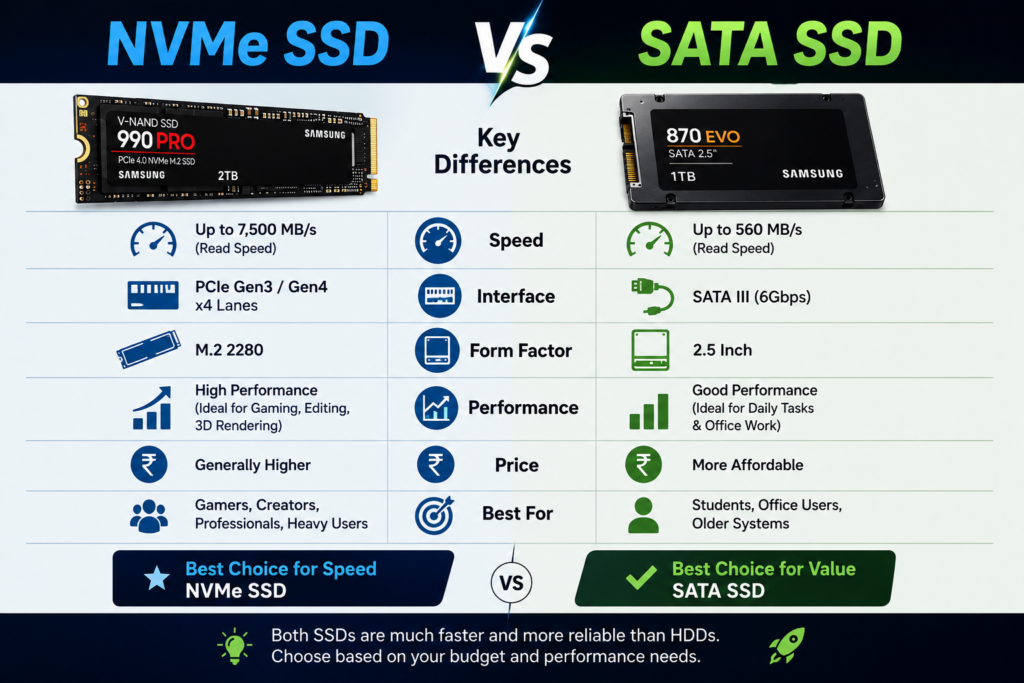
NVMe SSD vs SATA SSD A SATA SSD connects through the SATA III interface and offers read speeds of up to 560 MB/s, making it an excellent upgrade for older laptops and desktop computers. In contrast, an NVMe SSD uses the PCIe interface and the NVMe protocol, allowing read and write speeds of up to 7,500 MB/s on modern PCIe Gen4 drives.
This significant speed advantage makes NVMe SSDs the preferred choice for gamers, programmers, video editors, graphic designers, engineers, and professionals who work with large files and demanding applications. However, for everyday tasks such as web browsing, Microsoft Office, online learning, video streaming, and light multitasking, a SATA SSD still provides outstanding performance at a more affordable price.
When evaluating NVMe SSD vs SATA SSD, it is also important to consider factors such as your laptop’s motherboard compatibility, available M.2 slot, storage capacity requirements, TBW (Terabytes Written), warranty period, thermal performance, and overall budget. Leading manufacturers like Samsung, Western Digital, Crucial, Kingston, Lexar, and TeamGroup offer both SATA and NVMe SSDs with excellent reliability and long-term durability.
Throughout this comprehensive NVMe SSD vs SATA SSD guide, we compare boot times, gaming performance, application loading speeds, file transfer rates, video editing capabilities, programming performance, multitasking efficiency, power consumption, and value for money to help you determine which SSD is the best choice for your specific needs.
Whether you are upgrading an aging laptop with a SATA SSD or building a high-performance PC with a fast NVMe SSD, understanding the complete NVMe SSD vs SATA SSD comparison will help you make a smart investment that delivers faster performance, improved productivity, and a better overall computing experience for years to come.
Table of Contents
What Is an SSD?
A Solid State Drive (SSD) is a storage device that uses NAND flash memory to permanently store data. Unlike traditional hard disk drives, SSDs contain no moving mechanical parts. Instead, they rely on electronic memory chips to access and store information.
Because there are no spinning disks or moving read/write heads, SSDs are significantly faster, quieter, more durable, and more energy-efficient than HDDs.
Benefits of using an SSD include:
- Faster Windows boot times
- Quick application loading
- Better multitasking
- Faster file transfers
- Lower power consumption
- Improved laptop battery life
- Greater durability against drops and vibrations
- Reduced system noise
Today, almost every modern laptop and desktop computer includes an SSD as the primary storage device because it greatly improves the overall computing experience.
What Is a SATA SSD?
A SATA SSD is a solid-state drive that uses the Serial ATA (SATA) interface to communicate with the computer.
NVMe SSD vs SATA SSD Speed Comparison
NVMe SSD vs SATA SSD for Gaming
NVMe SSD vs SATA SSD Performance
SATA technology was originally developed for hard drives, and while SSDs connected through SATA are much faster than HDDs, they are limited by the maximum bandwidth of the SATA III interface.
Typical SATA SSD performance:
- Read Speed: Up to 560 MB/s
- Write Speed: Up to 530 MB/s
SATA SSDs remain a popular choice because they are affordable, widely compatible, and easy to install.
Advantages of SATA SSD
- Affordable pricing
- Compatible with many older laptops
- Easy installation
- Reliable performance
- Excellent upgrade from HDD
Best For
- Students
- Office users
- Home users
- Older laptops
- Budget-conscious buyers
What Is an NVMe SSD?
An NVMe SSD (Non-Volatile Memory Express SSD) is a modern storage device that connects directly to the motherboard using the PCI Express (PCIe) interface instead of SATA.
Unlike SATA, NVMe was designed specifically for flash memory, allowing SSDs to communicate much more efficiently with the processor.
Modern PCIe Gen4 NVMe SSDs commonly achieve:
- Read Speed: 5,000–7,500 MB/s
- Write Speed: 4,500–7,000 MB/s
This makes NVMe SSDs several times faster than SATA SSDs.
Advantages of NVMe SSD
- Extremely fast performance
- Lower latency
- Faster boot times
- Excellent multitasking
- Better gaming load times
- Superior video editing performance
- Faster software installation
Best For
- Gamers
- Programmers
- Video editors
- Graphic designers
- Engineers
- Content creators
- Professional users
NVMe SSD vs SATA SSD: Key Differences
Although both SSDs use flash memory, they differ in how they communicate with the computer and the level of performance they deliver.
| Feature | SATA SSD | NVMe SSD |
|---|---|---|
| Interface | SATA III | PCIe |
| Protocol | AHCI | NVMe |
| Maximum Speed | Around 560 MB/s | Up to 7,500 MB/s |
| Boot Time | Fast | Extremely Fast |
| File Transfer | Good | Excellent |
| Gaming | Good | Excellent |
| Video Editing | Good | Outstanding |
| Multitasking | Good | Excellent |
| Power Efficiency | Good | Excellent |
| Price | Lower | Higher |
The biggest difference is that NVMe SSDs are designed specifically for flash storage and make much better use of modern PCIe bandwidth.
SATA Interface Explained
The SATA interface has been widely used for many years and is still common in older laptops and desktop computers.
Characteristics include:
- Mature technology
- Excellent compatibility
- Maximum bandwidth of approximately 600 MB/s
- Affordable storage solutions
- Easy installation
For users upgrading from an HDD, even a SATA SSD provides a dramatic improvement in system responsiveness.
PCIe and NVMe Explained
PCI Express (PCIe) is a much faster communication interface than SATA.
NVMe was specifically developed to take advantage of PCIe’s higher bandwidth.
Benefits include:
- Lower latency
- Higher data transfer rates
- Better multitasking
- Improved responsiveness
- Faster application loading
- Superior gaming performance
- Better productivity for professionals
Modern PCIe Gen4 SSDs are capable of transferring several gigabytes of data every second, making them ideal for demanding workloads.
Why Choosing the Right SSD Matters
Many users assume that all SSDs perform similarly, but the storage device you choose has a direct impact on your laptop or desktop experience.
The right SSD can improve:
- Windows startup speed
- Game loading times
- Video editing workflows
- Software installation speed
- Large file transfers
- Virtual machine performance
- Application responsiveness
- Overall productivity
Choosing the wrong SSD may result in unnecessary spending or lower-than-expected performance.
Which Users Should Choose SATA or NVMe?
SATA SSD is Ideal For:
- Students
- Office users
- Home users
- Budget upgrades
- Older laptops
These users benefit from excellent everyday performance without paying extra for features they may never fully utilize.
NVMe SSD is Ideal For:
- Gamers
- Video editors
- Programmers
- Content creators
- Engineers
- Professionals
- Power users
Users handling large files or demanding applications will notice significant performance improvements with NVMe storage.
Performance Overview
Both SATA SSDs and NVMe SSDs are excellent storage solutions, but they serve different purposes.
A SATA SSD is more than enough for web browsingNVMe SSD vs SATA SSD, Microsoft Office, streaming, online learning, and everyday computing. It provides a huge leap in performance over a traditional HDD at an affordable price.
An NVMe SSD, however, is designed for users who need maximum speed. Tasks such as video editing, software development, gaming, virtualization, and large file transfers benefit greatly from its superior bandwidth and lower latency.
NVMe SSD vs SATA SSDUnderstanding these differences will help you make a smarter purchasing decision based on your actual needs rather than simply choosing the fastest or most expensive option.
NVMe SSD vs SATA SSD (2026): Which One Should You Buy?
NVMe SSD vs SATA SSD Speed Comparison
When comparing NVMe SSD vs SATA SSD, the biggest difference is speed. While both are much faster than traditional hard drives (HDDs), NVMe SSDs are designed to take full advantage of the PCIe interface, allowing them to deliver dramatically higher read and write speeds.
A SATA SSD is limited by the SATA III interface, NVMe SSD vs SATA SSD which offers a maximum theoretical bandwidth of 600 MB/s. In real-world use, most SATA SSDs achieve read speeds of around 550–560 MB/s and write speeds of 500–530 MB/s.
In contrast, modern NVMe SSDs connected through PCIe Gen4 can easily reach 5,000–7,500 MB/s, making them several times faster than SATA SSDs.
Speed Comparison Table
| Feature | SATA SSD | NVMe SSD |
|---|---|---|
| Interface | SATA III | PCIe Gen4 |
| Read Speed | Up to 560 MB/s | Up to 7,500 MB/s |
| Write Speed | Up to 530 MB/s | Up to 7,000 MB/s |
| Boot Speed | Fast | Extremely Fast |
| File Transfer | Good | Excellent |
| Large Projects | Good | Outstanding |
For users working with large files, videos, software projects, or virtual machines, the speed advantage of NVMe SSDs is immediately noticeable.
Windows Boot Time Comparison
One of the first improvements users notice after installing an SSD is faster startup time.
HDD
Average Boot Time:
- 60–120 Seconds
SATA SSD
Average Boot Time:
- 15–25 Seconds
NVMe SSD
Average Boot Time:
- 8–15 Seconds
Although NVMe SSDs boot Windows slightly faster than SATA SSDs, NVMe SSD vs SATA SSD the difference is smaller than many people expect. Once Windows has loaded, both drives provide a smooth user experience.
Winner:
NVMe SSD
Application Loading Performance
Applications launch much faster on SSDs than on HDDs.
Programs such as:
- Microsoft Word
- Microsoft Excel
- Adobe Photoshop
- Adobe Premiere Pro
- Visual Studio Code
- Google Chrome
- Microsoft Edge
open quickly on both SATA and NVMe SSDs.
For lightweight applications, the real-world difference between SATA and NVMe is minimal.
However, large professional software packages benefit significantly from NVMe storage.
Winner:
NVMe SSD
Gaming Performance
Gamers often ask whether upgrading to an NVMe SSD improves gaming performance.
The answer depends on what you mean by performance.
Does NVMe Increase FPS?
No.
Frame rate (FPS) is primarily determined by:
- Graphics Card (GPU)
- Processor (CPU)
- RAM
The storage drive has very little effect on FPS.
What NVMe Actually Improves
Compared with SATA SSDs, NVMe drives provide:
- Faster game installation
- Reduced loading screens
- Quicker level transitions
- Faster texture streaming
- Improved open-world game loading
Games that benefit include:
- Cyberpunk 2077
- Red Dead Redemption 2
- Forza Horizon 5
- Call of Duty
- GTA V
- Hogwarts Legacy
Winner:
NVMe SSD
File Transfer Performance
Large file transfers clearly demonstrate the advantage of NVMe SSDs.
Example:
Copying a 50GB folder.
SATA SSD:
Approximately 2–3 Minutes
NVMe SSD:
Approximately 20–40 Seconds
For photographers, video editors, and professionals who regularly move large files, NVMe SSDs save a considerable amount of time.
Winner:
NVMe SSD
Programming Performance
Developers frequently work with:
- Visual Studio
- Visual Studio Code
- Android Studio
- IntelliJ IDEA
- Docker
- Git
- Virtual Machines
While SATA SSDs perform well, NVMe SSDs provide faster project indexing, package installation, and code compilation.
Large software projects also load more quickly.
Winner:
NVMe SSD
Video Editing Performance
Applications such as:
- Adobe Premiere Pro
- DaVinci Resolve
- After Effects
- CapCut
benefit greatly from fast storage.
NVMe SSDs accelerate:
- Media import
- Preview generation
- Cache creation
- Timeline responsiveness
- Video exports
Professional editors working with 4K or 8K footage should strongly consider an NVMe SSD.
Winner:
NVMe SSD
Photo Editing Performance
Applications like:
- Adobe Photoshop
- Lightroom
- Canva
- GIMP
run well on both SATA and NVMe SSDs.
However, loading very large RAW image libraries and high-resolution projects is noticeably faster on NVMe storage.
Winner:
NVMe SSD
Multitasking Performance
Users who run multiple applications simultaneously benefit from NVMe storage.
Examples include:
- Chrome with 40+ tabs
- Photoshop
- Premiere Pro
- Spotify
- Teams
- Docker
- Virtual Machines
NVMe SSDs handle these workloads more efficiently due to their higher bandwidth and lower latency.
Winner:
NVMe SSD
Benchmark Comparison
| Task | SATA SSD | NVMe SSD |
|---|---|---|
| Windows Boot | ⭐⭐⭐⭐☆ | ⭐⭐⭐⭐⭐ |
| Application Launch | ⭐⭐⭐⭐☆ | ⭐⭐⭐⭐⭐ |
| Gaming Load Time | ⭐⭐⭐⭐☆ | ⭐⭐⭐⭐⭐ |
| Video Editing | ⭐⭐⭐⭐☆ | ⭐⭐⭐⭐⭐ |
| Programming | ⭐⭐⭐⭐☆ | ⭐⭐⭐⭐⭐ |
| File Transfer | ⭐⭐⭐⭐☆ | ⭐⭐⭐⭐⭐ |
| Photo Editing | ⭐⭐⭐⭐☆ | ⭐⭐⭐⭐⭐ |
| Multitasking | ⭐⭐⭐⭐☆ | ⭐⭐⭐⭐⭐ |
Real-World Performance
For everyday users browsing the internet, watching videos, using Microsoft Office, and attending online meetings,NVMe SSD vs SATA SSD both SATA SSDs and NVMe SSDs deliver an excellent experience. In these scenarios, the performance gap is relatively small.
However, users who frequently edit videos, develop software, work with virtual machines, or transfer large files will benefit much more from an NVMe SSD. The higher speeds reduce waiting time and improve overall productivity.
NVMe SSD vs SATA SSD If your laptop or desktop supports PCIe Gen4, investing in an NVMe SSD provides better long-term value and ensures your system is ready for future software demands.
Which SSD Performs Better?
For raw speed, responsiveness, and demanding workloads, the comparison between NVMe SSD vs SATA SSD clearly favors NVMe. While SATA SSDs remain an excellent choice for budget upgrades and older systems, NVMe SSDs deliver superior performance in almost every category.
If performance is your highest priority, NVMe is the clear winner. If affordability and compatibility matter most, SATA SSD still offers excellent value.
NVMe SSD vs SATA SSD (2026): Which One Should You Buy?
Power Consumption
When comparing NVMe SSD vs SATA SSD, many users focus only on speed. However, power consumption is also an important factor, especially for laptop users.
SATA SSDs generally consume less power during heavy workloads because they operate at lower speeds. Modern NVMe SSDs, however, have become much more energy-efficient thanks to improved controllers and PCIe Gen4 optimization. During light tasks such as web browsing, document editing, or video streaming, the battery life difference between the two is usually very small.
For most users, battery life should not be the deciding factor when choosing between an NVMe SSD and a SATA SSD.
Winner
Tie (Modern NVMe SSDs are highly efficient.)
Laptop Compatibility
Before purchasing an SSD, you must ensure that your laptop supports the correct storage interface.
SATA SSD Compatibility
A SATA SSD is compatible with:
- Most laptops released in the last 10–15 years
- Older desktop computers
- Systems with a 2.5-inch SATA drive bay
NVMe SSD Compatibility
An NVMe SSD requires:
- An M.2 slot
- PCIe support
- BIOS support for NVMe
Some laptops have an M.2 slot that supports only SATA drives, while others support PCIe NVMe drives. Always check your laptop’s specifications before buying.
Winner
Depends on your laptop
Installation Difficulty
Installing either SSD is relatively simple.
SATA SSD Installation
Steps include:
- Remove the laptop’s back panel
- Disconnect the old HDD or SSD
- Install the new SATA SSD
- Secure it with screws
- Install Windows or clone the existing drive
NVMe SSD Installation
Steps include:
- Locate the M.2 slot
- Insert the SSD at a slight angle
- Press it down gently
- Secure it with the mounting screw
Both upgrades can usually be completed in less than 30 minutes.
Winner
Tie
Price Comparison
Price is one of the biggest deciding factors.
SATA SSD
Advantages:
- Lower cost
- Better for budget upgrades
- Widely available
NVMe SSD
Advantages:
- Higher performance
- Better long-term investment
- Prices have become much more affordable
Although NVMe SSDs still cost slightly more in some cases, the price gap has narrowed considerably in recent years, making them an excellent value if your system supports them.
Winner
SATA SSD (for budget buyers)
Reliability
Both SATA and NVMe SSDs are highly reliable when purchased from trusted manufacturers.
Recommended brands include:
- Samsung
- Western Digital (WD)
- Crucial
- Kingston
- Lexar
- TeamGroup
These companies provide quality NAND flash memory, reliable controllers, firmware updates, and warranties ranging from three to five years.
Winner
Tie
Lifespan
The lifespan of an SSD depends on several factors:
- NAND flash quality
- TBW (Terabytes Written)
- Workload
- Temperature
- Controller quality
Under normal everyday use, both SATA and NVMe SSDs can easily last 5–10 years or longer.
For heavy workloads such as video editing or software development, choosing an SSD with a higher TBW rating is recommended.
Winner
Tie
Heat Generation
Because NVMe SSDs operate at much higher speeds, they generate more heat than SATA SSDs during sustained workloads.
Many premium NVMe drives include:
- Thermal throttling protection
- Improved controllers
- Better power management
Desktop systems often use heatsinks, while many laptops rely on built-in cooling solutions.
For everyday tasks, heat is rarely an issue.
Winner
SATA SSD
Storage Capacity Options
Both SATA and NVMe SSDs are available in multiple capacities.
Common options include:
- 250GB
- 500GB
- 1TB
- 2TB
- 4TB
Some high-end NVMe SSDs are also available in larger capacities, making them suitable for professionals who work with massive datasets or media libraries.
Winner
Tie
Pros and Cons
SATA SSD
Pros
- Affordable
- Excellent compatibility
- Easy installation
- Reliable performance
- Ideal for older laptops
- Lower heat generation
Cons
- Limited by SATA interface
- Slower than NVMe SSDs
- Not ideal for demanding workloads
NVMe SSD
Pros
- Extremely fast read/write speeds
- Faster Windows boot
- Better gaming load times
- Excellent for video editing
- Outstanding multitasking
- Future-ready technology
Cons
- Slightly more expensive
- Generates more heat under heavy load
- Requires NVMe-compatible hardware
Which SSD Should You Buy?
Choose a SATA SSD If You:
- Have an older laptop
- Need an affordable upgrade
- Use Microsoft Office
- Browse the internet
- Watch videos
- Attend online classes
- Want a simple replacement for an HDD
Choose an NVMe SSD If You:
- Own a modern laptop or desktop
- Play modern games
- Edit videos regularly
- Develop software
- Use virtual machines
- Transfer large files frequently
- Want the fastest possible performance
Best SSD Recommendations
Best Overall
Samsung 990 EVO
Excellent speed, reliability, and efficiency for most users.
Best Budget NVMe SSD
Kingston NV3
Great value with strong everyday performance.
Best Gaming SSD
WD Black SN770
Fast loading times and excellent gaming performance.
Best SATA SSD
Samsung 870 EVO
Reliable, durable, and perfect for upgrading older laptops.
Best Professional SSD
Kingston KC3000
Ideal for demanding workloads such as 4K video editing and software development.
Final Comparison Table
| Feature | SATA SSD | NVMe SSD |
|---|---|---|
| Speed | ⭐⭐⭐☆☆ | ⭐⭐⭐⭐⭐ |
| Gaming | ⭐⭐⭐⭐☆ | ⭐⭐⭐⭐⭐ |
| Video Editing | ⭐⭐⭐☆☆ | ⭐⭐⭐⭐⭐ |
| Programming | ⭐⭐⭐⭐☆ | ⭐⭐⭐⭐⭐ |
| Multitasking | ⭐⭐⭐⭐☆ | ⭐⭐⭐⭐⭐ |
| File Transfer | ⭐⭐⭐☆☆ | ⭐⭐⭐⭐⭐ |
| Compatibility | ⭐⭐⭐⭐⭐ | ⭐⭐⭐⭐☆ |
| Price | ⭐⭐⭐⭐⭐ | ⭐⭐⭐⭐☆ |
| Heat | ⭐⭐⭐⭐⭐ | ⭐⭐⭐⭐☆ |
| Future-Proofing | ⭐⭐⭐☆☆ | ⭐⭐⭐⭐⭐ |
Real-World Verdict
The NVMe SSD vs SATA SSD debate ultimately comes down to your needs and hardware compatibility. If your laptop supports NVMe and your budget allows, an NVMe SSD is the better long-term investment. Its superior speed, lower latency, and better multitasking performance make it ideal for gaming, content creation, programming, and professional work.
On the other hand, SATA SSDs continue to be an excellent choice for older systems and budget-conscious users. They offer a huge performance improvement over traditional hard drives, making everyday tasks much faster and more enjoyable.
Whichever option you choose, upgrading from an HDD to an SSD is one of the most effective ways to improve your computer’s overall performance.
NVMe SSD vs SATA SSD (2026): Which One Should You Buy?
Complete SSD Buying Guide
When deciding between NVMe SSD vs SATA SSD, don’t choose based on speed alone. Consider your laptop or desktop compatibility, budget, workload, and future requirements. A student, office worker, gamer, programmer, and video editor all have different storage needs.
The following guide will help you make the right decision.
Step 1: Check Compatibility
Before purchasing an SSD, verify which interface your computer supports.
SATA SSD
Supports:
- Older laptops
- Older desktop PCs
- 2.5-inch SATA drive bay
NVMe SSD
Requires:
- M.2 slot
- PCIe support
- NVMe compatibility
Always check the manufacturer’s specifications before ordering.
Step 2: Choose the Right Capacity
256GB
Suitable for:
- Windows
- Office work
- Students
500GB
Suitable for:
- Daily users
- Professionals
- Programming
1TB
Ideal for:
- Gaming
- Content creation
- Video editing
2TB+
Best for:
- Professional creators
- Large project files
- Heavy multitasking
Step 3: Select a Trusted Brand
Reliable brands include:
- Samsung
- Western Digital
- Crucial
- Kingston
- Lexar
- TeamGroup
These manufacturers are known for consistent performance, firmware updates, and dependable warranty support.
Step 4: Compare Warranty
Choose SSDs with at least a 5-year warranty whenever possible. A longer warranty often reflects better build quality and greater manufacturer confidence.
Step 5: Check Endurance (TBW)
TBW (Terabytes Written) measures how much data can be written to an SSD over its lifespan.
A higher TBW rating is especially valuable for:
- Video editors
- Software developers
- Gamers
- Users who frequently transfer large files
Common Buying Mistakes
Avoid these mistakes when shopping for an SSD:
- Buying without checking compatibility
- Choosing the cheapest model only
- Ignoring warranty and TBW
- Purchasing insufficient storage
- Confusing M.2 SATA with M.2 NVMe
- Forgetting to update firmware
- Not backing up your data before upgrading
Frequently Asked Questions (FAQs)
Which is faster: NVMe SSD or SATA SSD?
NVMe SSDs are significantly faster because they use the PCIe interface instead of SATA. Modern NVMe drives can be several times faster in read and write speeds.
Is NVMe worth the extra money?
If your computer supports NVMe and you work with games, large files, programming, or video editing, then yes. For basic web browsing and office tasks, a SATA SSD is often sufficient.
Does an NVMe SSD improve FPS?
No. An NVMe SSD does not directly increase frame rates, but it does reduce game loading times and can improve asset streaming in supported games.
Can I replace an HDD with an SSD?
Yes. Replacing a hard drive with an SSD is one of the best upgrades you can make. Your system will boot faster, applications will launch more quickly, and overall responsiveness will improve.
Which SSD is better for gaming?
An NVMe SSD is generally the better option because it offers faster loading times and smoother performance in modern games.
Which SSD lasts longer?
Both SATA and NVMe SSDs have similar lifespans when they use high-quality components and are used under normal conditions. The key factors are the SSD’s TBW rating and build quality.
Is SATA SSD still worth buying in 2026?
Yes. If you have an older laptop or desktop that doesn’t support NVMe, a SATA SSD remains an excellent upgrade and offers a major performance boost over an HDD.
Final Verdict
The comparison between NVMe SSD vs SATA SSD comes down to your specific needs.
If you own a modern laptop or desktop with NVMe support, an NVMe SSD is the best choice for speed, multitasking, gaming, content creation, and future-proof performance. It delivers significantly faster read and write speeds and improves demanding workflows.
However, SATA SSDs continue to be a fantastic option for users with older systems or tighter budgets. They are reliable, affordable, easy to install, and provide a dramatic upgrade over mechanical hard drives.
No matter which type you choose, switching from an HDD to an SSD will greatly improve your computer’s speed, responsiveness, and overall user experience.
https://www.westerndigital.com
https://www.westerndigital.com
https://www.westerndigital.com
https://www.computric.in/best-ssd-for-laptop-in